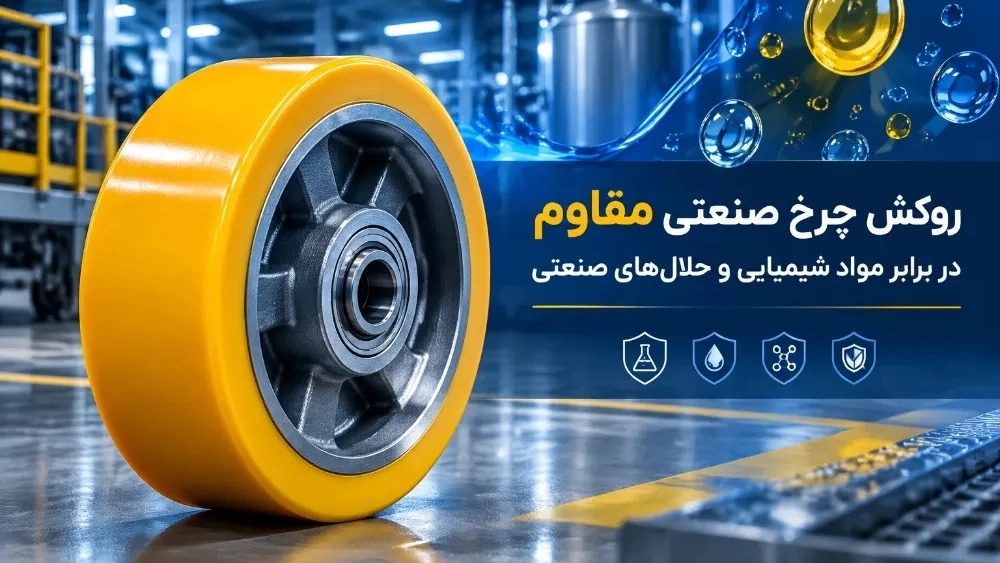
In many industrial environments, wheels and moving equipment are constantly exposed to chemicals, oils, grease, industrial solvents, acids and other corrosive substances. Using a normal wheel in such conditions can cause rapid wear of the coating, decrease the performance of the wheel, crack the surface and finally increase the costs of repairing and replacing the equipment. For this reason, choosing an industrial wheel coating resistant to chemicals and industrial solvents is one of the important factors in increasing the life of the equipment and maintaining the safety of the work environment.
The industrial wheel cover should be selected according to the type of application, portable weight, floor material, ambient temperature and also the type of chemicals in the environment. In various industries, including chemical, petrochemical, pharmaceutical, food, automotive, paint and resin industries, and manufacturing workshops, choosing a suitable coating can have a direct impact on equipment performance.
Aria Sanat Isfahan, focusing on the production and supply of equipment and parts used in industrial environments, can be a suitable option for groups that are looking for specialized solutions in the field of industrial wheels and resistant coatings.
Why should industrial wheel coating be resistant to chemicals?
In many production lines, industrial wheels are responsible for moving devices, trolleys, industrial tables, warehouse equipment and other heavy equipment. When these wheels are exposed to chemicals, the coating material becomes very important.
An industrial wheel cover resistant to chemicals and industrial solvents should be able to withstand continuous or periodic contact with chemicals. If the wheel cover does not have enough resistance, its surface may become soft, swollen, dry or brittle.
These changes can cause various problems; For example:
- Decreasing the useful life of the wheel
- Creating cracks on the coating surface
- Separation of the coating from the wheel core
- Reducing load bearing capacity
- Increasing friction during movement
- Damage to the hall floor
- Increasing maintenance cost
- Reducing the safety of mobile equipment
Therefore, choosing the right cover is not just a technical issue; Rather, it is considered part of the industrial equipment maintenance program.
Characteristics of chemical resistant industrial wheel coating
A suitable coating for use in industrial environments should have different characteristics. The importance of each feature also depends on the type of industry and working conditions.
Resistance to industrial solvents
For this reason, when choosing an industrial wheel cover resistant to chemicals and industrial solvents, it should be determined what materials the wheel will be in contact with.
Type of solvent, concentration, duration of contact, ambient temperature and number of times of contact are among the factors that affect the performance of the coating.
Resistance to oil and grease
In many industrial workshops, wheels are in close proximity to industrial oils, lubricants and grease. Penetration of these materials to some coatings can change their mechanical properties.
A suitable coating should be able to maintain its performance to an acceptable level in such an environment and not undergo deformation or rapid destruction.
High mechanical resistance
Chemical resistance alone is not enough. An industrial wheel may be subjected to heavy pressure, impact and continuous movement at the same time.
Therefore, Industrial wheel coating should have good mechanical strength in addition to chemical resistance. The correct choice of cover should be based on the weight of the equipment and the conditions of movement.
Abrasion resistance
Abrasion is one of the most important factors in reducing the life of industrial wheels. Continuous movement on hard, uneven or dirty surfaces can cause coating erosion.
Using a wear-resistant coating can reduce the number of wheel replacements and control maintenance costs.
Types of materials used for coating industrial wheels
One of the most important steps in choosing an industrial wheel cover resistant to chemicals and industrial solvents is knowing the type of cover. Different materials are used to make wheel covers and each one has its own characteristics.
Polyurethane coating
Polyurethane is one of the widely used materials in manufacturing industrial wheels. This material is used in many industries due to its good resistance to wear, load bearing and ability to be used in various applications.
Polyurethane wheels also produce less noise when moving compared to some metal wheels and can cause less damage to the floor if chosen correctly.
Of course, the chemical resistance of polyurethane depends on the formulation and type of chemical substance, and one type of polyurethane cannot be considered suitable for all chemicals.
Rubber coating
Rubber is also one of the common materials for wheel covers. Rubber wheels usually have good impact properties and are a suitable option for some industrial environments and different surfaces.
However, the type of tire is very important; Because all rubber compounds do not have the same performance against solvents, oils and chemicals.
Nylon and polyamide coating
In some industrial applications, hard polymer materials such as nylon and polyamide are used. These materials can have good resistance against some chemicals and be a suitable option for special industrial environments.
The selection of these materials should be done based on the actual work conditions; Because the chemical resistance of any polymer compound depends on the type of material, temperature and contact conditions.
What factors are important in choosing an industrial wheel cover?
Choosing industrial wheel coating resistant to chemicals and industrial solvents should not be done solely based on the material of the coating. To reach the correct choice, a set of factors should be checked.
Chemical type
The first question is what exactly the wheel is in contact with. Acids, bases, alcohols, organic solvents, oils and detergents may have different reactions with coating ingredients.
ambient temperature
High or low temperature can change the properties of polymer materials. Therefore, if the wheel is used in a hot environment, a cold room or in the vicinity of heating equipment, the temperature range of the coating should be checked.
amount of load
The weight of the equipment and the transported load is a very important factor. The wheel cover must be able to bear the intended load.
If the capacity of the wheel is less than the actual need, the possibility of deformation, rapid wear and reduced useful life increases.
floor type
The type of floor also affects the choice of cover. Concrete, epoxy, ceramic, metal, or different industrial surfaces can behave differently against wheels.
In environments where the health of the floor is very important, choosing the right wheel and cover can prevent the creation of lines and damage on the surface.
speed of movement
Wheels used on high-speed moving equipment have different requirements than those used on hand trolleys.
Speed, frequency of movement and amount of load should all be taken into consideration when choosing a cover.
Application of chemical resistant coatings in different industries
Industrial wheel coating resistant to chemicals and industrial solvents can be used in a wide range of industries.
Chemical industry
In chemical factories, the equipment is more likely to come into contact with corrosive substances and solvents. In such environments, choosing the right wheel is very important.
Pharmaceutical industry
In pharmaceutical factories, in addition to chemical resistance, hygiene requirements and equipment cleaning are also important. The wheel should be selected according to the environment and production process.
Food industry
Inner transport equipment in the food industry may be regularly washed and disinfected. Therefore, the coating's resistance to detergents and washing conditions becomes important.
Automotive industry
In automotive and auto parts production lines, wheels may come into contact with oil, grease, detergents, and other industrial materials. Using the right wheel can help increase the life of moving equipment.
Paint and resin industries
Paint, resin and coating production environments usually deal with a variety of solvents and chemical compounds. In this situation, choosing an industrial wheel coating resistant to chemicals and industrial solvents becomes particularly important.
Advantages of using suitable industrial wheel cover
Choosing the right cover can have various advantages for industrial complexes.
Increase wheel life
Good resistance to chemicals, wear and pressure can make the wheel last longer.
Reduce maintenance cost
Frequent replacement of wheels is expensive. Choosing the right coating from the beginning can reduce the need for early repair and replacement.
Increased safety
Coating wear may make equipment movement difficult or unpredictable. Using the right wheel can help the equipment operate more safely.
Reduce damage to the floor
Some industrial coatings are designed to move more smoothly on surfaces and, if chosen correctly, reduce the possibility of damage to the floor.
Better equipment performance
The right wheel makes mobile equipment move with less force and makes it easier to move in the factory environment.
Why is it important to choose the right supplier?
Even if the best coating material is chosen, the quality of the final design and construction of the wheel is also very important. The quality of the raw materials, the production method, the connection of the cover to the core, the dimensions of the wheel and the quality of the bearing or the motion system can all affect the final performance.
For this reason, it is better to buy industrial wheel cover resistant to chemicals and industrial solvents from a collection that can suggest the right product based on the actual application conditions.
Aria Sanat Isfahan; A choice for industrial equipment and wheels
Aria Sanat Isfahan, operating in the field of industrial equipment and necessities, can be an option to consider for groups that are looking for suitable solutions for moving equipment and using industrial wheels.
One of the important points in buying an industrial wheel is not to choose the product based solely on price. Environmental conditions, weight of equipment, type of floor, amount of use and possible contact with chemicals should be included in the selection process.
Aria Sanat Isfahan can provide guidance in choosing the right product for various industrial applications by examining the customer's needs. This issue is especially important for sets that work in production environments with oil, grease, detergents, solvents or other chemicals.
Important points when ordering industrial wheel covers
Before ordering industrial wheel coating resistant to chemicals and industrial solvents, it is better to know the following information:
- Equipment weight and maximum portable load
- Number of wheels installed on the equipment
- Type of chemicals in the environment
- Duration and amount of wheel contact with chemicals
- Working environment temperature
- Type of hall floor
- Equipment movement rate and speed
- Washing and cleaning conditions
- The importance of noise reduction
- Wheel dimensions and specifications desired
Providing this information helps the manufacturer or supplier to suggest a more suitable option.
Is every industrial wheel coating resistant to all chemicals?
No. This point is very important. The phrase "resistant to chemicals" does not mean the same resistance to all chemicals.
For example, a material may perform well against oil, but show less resistance against a particular solvent. Also, increasing the temperature or prolonging the contact time can change the amount of chemical resistance.
Therefore, to choose an industrial wheel coating resistant to chemicals and industrial solvents, the specific chemical substance, concentration, temperature and contact conditions should be considered.
In sensitive applications, checking the manufacturer's technical information and, if necessary, performing a compatibility test can prevent incorrect selection.
summary
Using industrial wheel coating resistant to chemicals and industrial solvents is considered a technical necessity for many production and industrial environments. Contact with solvents, oils, detergents and chemical compounds can reduce the performance of inappropriate coatings over time.
The correct choice should be made based on a set of factors including type of chemical, ambient temperature, amount of load, type of floor, speed of movement, amount of wear and conditions of use. Also, the material of the coating, the quality of construction and the way it is connected to the wheel core are factors that affect the final performance.
If you are looking for an industrial wheel cover resistant to chemicals and industrial solvents for your factory, workshop or industrial complex, check the specifications of the working environment and the type of chemicals before purchasing and choose the product that fits the actual conditions.
Aria Sanat Isfahan, as one of the active collections in the field of industrial equipment and supplies, can be an option for checking and meeting the needs related to wheels and industrial moving equipment. Choosing the right product for the application, in addition to increasing the life of the equipment, can help reduce maintenance costs and improve the productivity of industrial operations.
A single material cannot be considered the best for all applications. Polyurethane, rubber, nylon and other polymer materials each have different characteristics. The right choice should be made based on the weight of the load, the type of floor, the amount of wear, the ambient temperature and the available chemicals.
In many industrial applications, polyurethane is used due to its good wear resistance, load bearing and good performance on different surfaces. However, its chemical resistance depends on the type and formulation of polyurethane.
This depends on the type of cover. Some coating materials have good resistance to oil and grease, while others may change properties after prolonged contact. For this reason, choosing an industrial wheel coating resistant to chemicals should be done according to the environmental conditions.