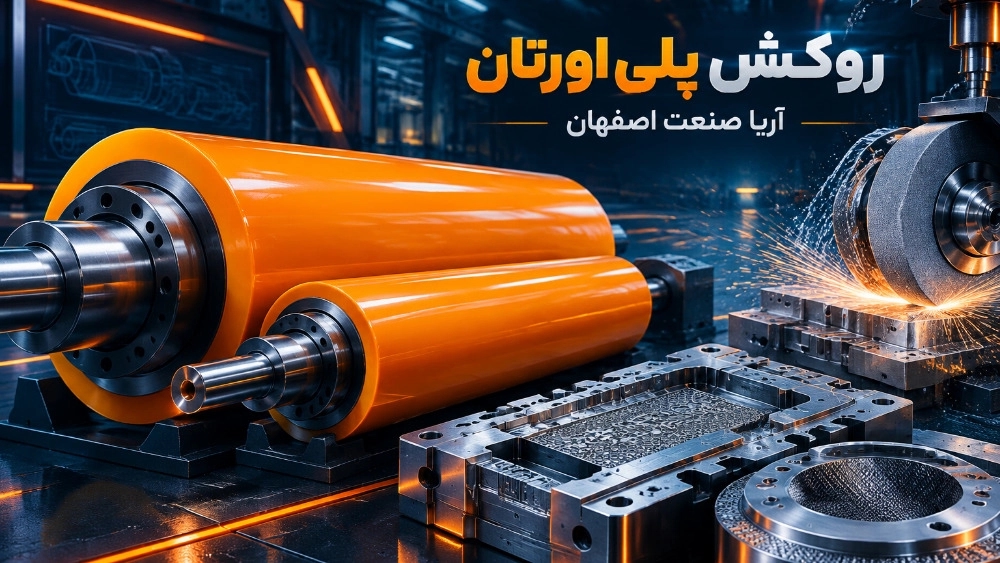
Modern industries rely on advanced polymer materials to increase component life, reduce wear, and resist wear, oils, and chemicals. In the meantime, polyurethane coatings have found a special place in production lines due to their unique mechanical properties such as tensile strength, high toughness, vibration absorption and extraordinary wear resistance. As one of the main centers of industry and production in the country, the city of Isfahan has the highest demand for these specialized services. A detailed examination of Isfahan's polyurethane coating service implementation stages, from molding to grinding, shows that achieving the highest quality requires deep technical knowledge, advanced equipment, and executive experience; Services provided by Arya Sanat Isfahan, relying on international standards, to the steel, printing and packaging, textile, tile and ceramic industries.
Polyurethane is an elastomer that is a bridge between the elasticity of rubber and the hardness of plastic. The correct implementation of polyurethane coating on rollers, wheels and industrial parts is a complex and sensitive process, and if there is a defect in any of its steps, the molecular bond of polyurethane with the metal core will suffer and the part will lose its efficiency in a short period of time. In the continuation of this specialized article, we analyze all the engineering steps from design and molding to surface preparation, injection and final grinding.
The importance and benefits of using polyurethane coating in industrial parts
Before entering into the technical details of the steps, it is important to know the reasons why polyurethane is superior to other coatings such as ordinary rubber or Teflon. Polyurethane is an elastomer that, due to its network structure, can withstand heavy mechanical stress without being deformed. In the industrial environments of Isfahan where there are heavy dynamic loads and abrasive environments, this material is the best choice of engineers.
The abrasion resistance of polyurethane is several times that of natural and synthetic rubbers, and it is not destroyed in frequent contact with rough surfaces. This material has excellent resistance to all kinds of industrial oils, solvents, grease and petroleum materials and does not swell or change dimensions in oily environments. In addition, its wide range of hardness varies from very soft Salt A to very hard Salt D and provides the possibility of customization based on the needs of each production line. High shock and vibration absorption, tear and corrosion resistance, and reducing noise pollution in production lines have made polyurethane an unbeatable option. Aria Sanat Isfahan collection with special formulation of raw materials guarantees these mechanical properties for the most difficult working conditions.
First step: checking, dimensioning and engineering of the work piece
The first step in the implementation of Isfahan polyurethane coating services is to carefully check the condition of the base part and its working conditions. The technical experts of Aria Sanat Isfahan check the technical drawing and the amount of stress on the part before any action. This evaluation includes determining the final dimensions, the thickness of the polyurethane layer, the required hardness based on the Shor A or Shor D scale, and the linear or rotational speed of the roller.
At this stage, environmental conditions such as continuous working temperature, type of chemicals in contact, type of friction and humidity level are determined. Based on these data, the appropriate type of prepolymer and curing agent is selected. If the metal core is warped, broken or worn by the journals, it is modified and warped in the machining workshop of Aria Sanat Isfahan and then enters the coating cycle.
Second step: designing and making a precise industrial mold
Moulding is one of the determining elements in the quality, density and absence of bubbles in polyurethane coating. The mold must be made with high precision to ensure uniform heat transfer during baking and the molded polyurethane has uniform dimensions with minimum deviation.
Forms are mainly made of quality steel or aluminum alloy. Accurate machining of the inner walls of the mold with CNC machines makes the external surface of the part take shape without distortion and dimensional deviation. Aria Sanat Isfahan has provided the possibility of vertical and horizontal molding for heavy and delicate rollers with the highest efficiency by using engineered molds equipped with gas guiding grooves and sealing caps. The use of high-quality thermal release agents on the wall of the mold makes it possible to easily separate the part after baking without damaging the elastomer texture.
The third step: preparing the surface of the metal brain and sandblasting
The mechanical and chemical bond between the polyurethane and the metal surface is the most critical factor in the coating's durability. Any contamination, grease, rust or metal oxide will prevent complete adhesion and cause the coating to peel off under pressure. In Isfahan's Aria Sanat complex, surface preparation is done through a multi-stage engineering protocol.
First, industrial washing and deep degreasing are performed with specialized solvents to remove oils and lubricants. Then the sandblasting or shotblasting process is done with standard abrasives such as steel grit or aluminum oxide. This operation removes rust and creates a suitable roughness profile on the metal. Creating this rough microscopic texture increases the contact area and maximizes the physical grip between the metal and the polyurethane coating.
Fourth step: applying primer and adhesion surface activators
Immediately after sandblasting and before oxidizing the metal surface, specific polyurethane primers are applied. Primers are advanced chemical substances that, on the one hand, establish a covalent bond with the metal surface, and on the other hand, during injection, they react with polymer chains and create an unbreakable chemical bond.
Area Sanat Isfahan technologists use the most advanced two-component elastomeric primers with micron controlled thickness. After applying the primer, the metal is placed in the thermal ovens with a certain temperature so that the adhesive layer reaches the thermal activation stage. This accuracy in applying the primer guarantees the flawless performance of the polyurethane coating against shear pressures and severe dynamic stresses.
Fifth step: preparation of materials, formulation and vacuum degassing
Industrial polyurethane, which is produced by hot casting, is made from a precise combination of prepolymers and diamine or polyol curing agents. Accuracy in weighing, temperature control and homogeneous mixing of these materials directly affects the anti-wear properties, elasticity and hardness of the final coating.
One of the main challenges in polyurethane coating is the existence of small air bubbles in the material, which, if not removed, will cause air pockets and reduce wear resistance and quality loss in the grinding stage. In the specialized workshop of Aria Sanat Isfahan, the raw materials are degassed in vacuum tanks before mixing, so that all trapped air is evacuated. This operation ensures that the elastomer structure is completely dense, uniform and without any microscopic bubbles.
The sixth step: injection, casting and initial baking in the furnace
After preparing the core and raw materials, the metal core is placed and centered inside the preheated mold. It is necessary to maintain the concentricity of the shaft with the wall of the mold in order to achieve a uniform thickness of polyurethane throughout the part.
The molten polyurethane compound is slowly injected into the mold at a certain temperature and at a set speed. Continuous injection from the bottom to the top prevents air bubbles from being trapped in the part structure. After the mold is filled, the set enters the thermal ovens with hot air circulation so that the gel time and initial baking process can be done under strict temperature control. Aria Sanat Isfahan, by using modern injection equipment and calibrated elemental furnaces, brings the uniform formation of transverse joints in the polyurethane structure to the highest level.
Seventh step: Demolding and secondary baking
After finishing the initial curing and the elastomer reaches the appropriate structural strength, the mold is removed from the oven and the part is carefully removed from the mold without creating mechanical stress, which is called demoulding. At this moment, although the part has taken the final shape, the polymer network has not yet reached its maximum mechanical properties.
The piece is again placed in the final baking oven for a certain period of time. This step, which is called secondary curing, brings the molecular chains to the maximum density and completes properties such as tear resistance, rebound flexibility and dimensional stability. Aria Sanat Isfahan implements the thermal curing cycle based on the material's technical specification sheet to achieve the highest shelf life.
Eighth step: precise turning and grinding of polyurethane coating
The last and most sensitive physical step in the chain of polyurethane coating services is machining, turning and grinding. Due to the high elasticity and toughness of polyurethane, its turning and grinding requires special abrasive stones with a controlled chipping cycle and advanced soapy water equipment so that the surface does not burn or deform.
Rollers and industrial parts require very accurate dimensional adaptations and balance. In the grinding unit of Aria Sanat Isfahan, the parts are placed on advanced stone-oriented machines. In this process, micron peeling is done until reaching the nominal diameter, the smoothness of the surface and the roughness desired by the customer. Also, if the production line requires, the creation of spiral, chevron, rhombus or water guiding grooves on the surface of the polyurethane coating is performed with CNC precision.
Ninth step: final quality control, hardness measurement and packaging
Before delivering the piece to the craftsman, comprehensive quality control tests are performed in the Isfahan Aria Sanat laboratory. These controls ease the imagination of production line managers due to the perfect performance of the part.
Quality control tests include hardness measurement at several points of the roller surface to check the uniformity of baking, measurement of geometric tolerances with micrometer tools, lack of laxity and eccentricity test, and adhesion test of the coating to the metal. After the approval of the quality unit, the parts are packed in industrial protective covers to prevent physical damage and absorb dust and are ready to be sent to the factories.
Why is Aria Sanat Isfahan the best choice for polyurethane coating services?
Finding a committed and experienced center for the supply and coating of industrial parts is one of the concerns of factories. Aria Sanat of Isfahan is known as a reliable name in this field with years of brilliant experience in the field of polymer engineering and elastomeric coatings. Relying on first-class European and Asian materials, the most advanced grinding and injection machines and experienced engineering staff, this collection produces parts with long life and smooth operation.
Fast delivery of orders, the possibility of special formulation according to the working temperature and chemical conditions of the part, the guarantee of adhesion quality and continuous technical support are the distinguishing points of Aria Sanat Isfahan. In order to receive engineering advice, inquire about the price and place an order for Isfahan polyurethane coating services, contacting the experts of Aria Sanat Isfahan is a sure step towards increasing the productivity of your production lines.
summary
The implementation steps of Isfahan polyurethane coating services is a specialized and chain process including part engineering, precise molding, surface preparation, controlled injection, calibrated thermal curing and micron grinding. The perfect execution of each of these steps improves the wear resistance, chemical stability and useful life of the parts in the harshest industrial conditions. Choosing a leading group such as Aria Sanat Isfahan will guarantee the maintenance of construction standards and saving on repair and maintenance costs of factories.
Polyurethane has several times higher abrasion resistance, better chemical and oil resistance, and much higher load bearing capacity.
Depending on the dimensions of the piece, the need to make a new mold and the circulation usually varies between 3 and 7 working days.
The hardness can be adjusted according to the type of application, the amount of contact pressure and friction required by the production line from 50 Shore A to 75 Shore D.